Booking a Visit
We run out of Wenatchee, 19 miles from Waterville, so there's no local branch to swing by - every visit here is a scheduled trip, not a drive-by. That's not a knock against the town; it just means we plan the truck's day around getting to you instead of you coming to us. When you call, tell us what the door is doing (won't open, grinding, sagging on one side) so we can bring the right spring size, cable length, or opener part rather than guessing and making a second trip.
Waterville is one of the farther stops on our map, tied with Leavenworth at 19 miles out, so we tend to batch calls out this way rather than send a truck for a single loose hinge. If your problem isn't urgent - a noisy roller, a slow opener - mentioning that when you book helps us slot you in efficiently. If a spring has already let go and the door won't move, say so; that's a safety issue and it jumps the line regardless of distance.
How It Shows Up
Waterville's housing stock runs older than most of the towns we cover - the median build year here is 1944, well ahead of the 1977 median across the wider service area. That matters because a house built in the mid-1940s was framed before torsion springs were the standard residential setup; a lot of these garages still run (or started life with) extension springs mounted along the horizontal track, with open coils that pinch fingers and stretch unevenly with age.
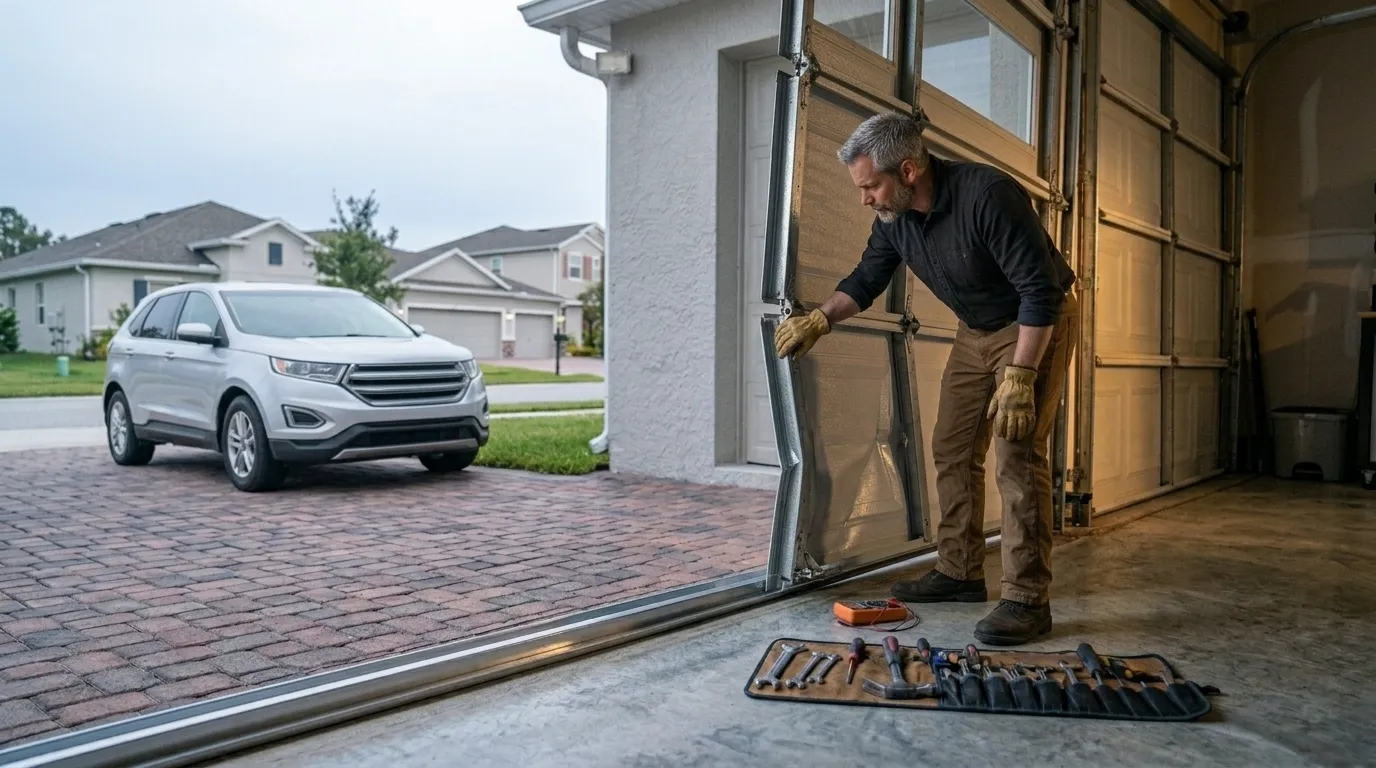
On a door that old, the failure doesn't always look like a broken spring. It shows up as the door hanging crooked, one side dropping faster than the other, or a door that slams down the last foot because the spring tension bled off years ago and nobody replaced it - they just lived with it. Track brackets original to a 1940s build are often lag-bolted into jamb wood that's shrunk and split over eight decades, so even a straight track can be loose at every hanger. None of this is dramatic to look at. It's just old hardware doing exactly what old hardware does.
Can You Do This Yourself
Some of this is fine to handle on your own. Lubricating rollers and hinges, tightening visible bolts, clearing the track of debris - that's normal upkeep and doesn't need a call.
Spring work on any door, but especially on original 1940s extension spring setups, isn't a do-it-yourself job. The spring is under load even when the door looks still, and on hardware this old the mounting points have often corroded in ways you can't see from the floor. We'd rather you call for that than end up with a cable whipping loose.
One honest limit: if the track brackets are bolted into jamb wood that's split or punky, sometimes the fix isn't a new bracket - it's carpentry work we don't do. In that case we'll tell you straight and point you to what actually needs fixing before hardware gets reattached to it.